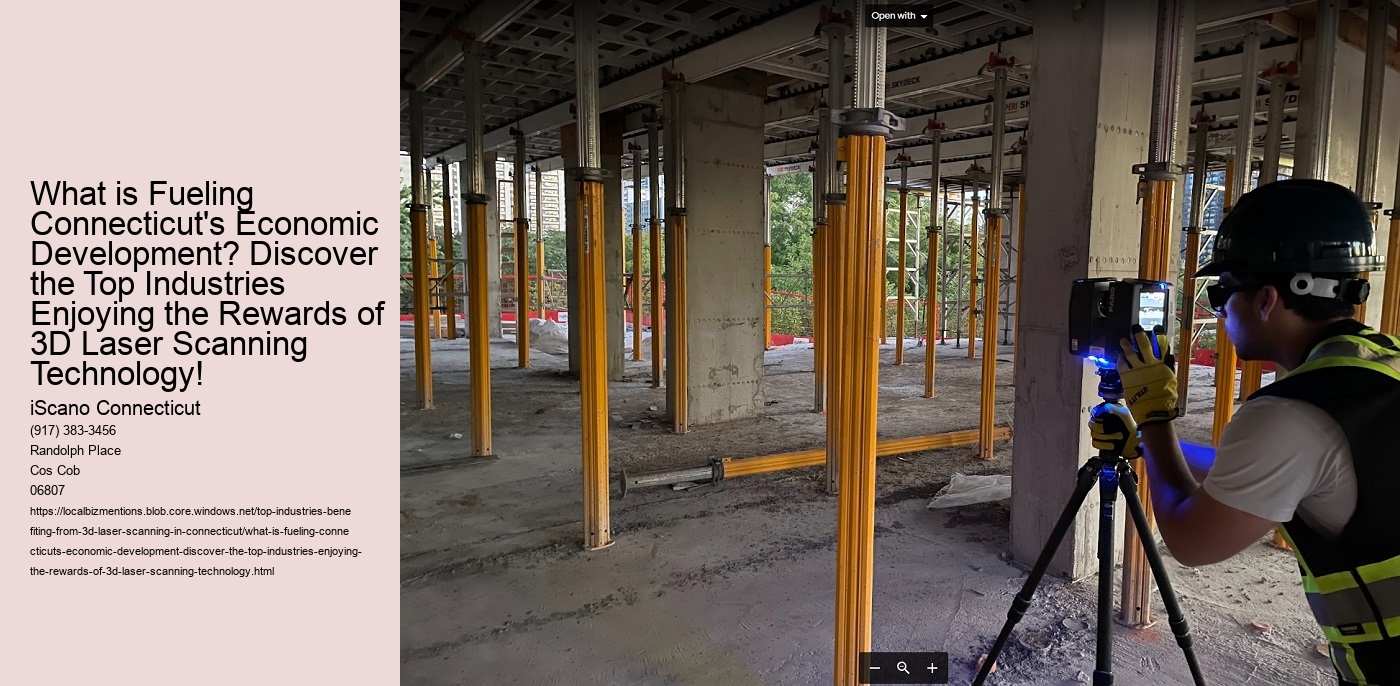
As Connecticut remains to navigate the waves of financial development, it's coming to be increasingly clear that modern technology plays a crucial role in sustaining development and competitiveness. What is Sustaining Connecticut's Economic Development? Discover the Top Industries Reaping the Benefits of 3D Laser Scanning Technology! . Amongst the various technological advancements, 3D laser scanning technology has actually become a transformative force across several sectors within the state. This essay offers a review of 3D laser scanning technology and highlights the top sectors in Connecticut reaping its advantages.
3D laser scanning, additionally known as LiDAR (Light Detection and Ranging), is a non-contact, non-destructive modern technology that electronically catches the form of physical things using a line of laser light. This innovation develops "" point clouds"" of information from the surface area of an item. In essence, 3D laser scanners determine great information and capture free-form forms to swiftly generate very precise factor clouds. It is extensively pertained to for its accuracy, rate, and adaptability.
In Connecticut, the aerospace market stands as a key recipient of 3D laser scanning technology. The state is home to a significant variety of aerospace makers who depend on the extreme accuracy of 3D laser scanning to create elements that fulfill strenuous safety and security and top quality standards. The innovation allows rapid prototyping, quality control, and the ability to reverse-engineer get rid of intricate geometries, hence lowering time-to-market for new developments.
The construction and architecture fields also significantly benefit from 3D laser scanning. In a state with an abundant tapestry of historic structures and modern infrastructure, keeping and refurbishing frameworks calls for thorough planning and execution. 3D laser scanning gives architects and designers with thorough versions of existing frameworks, allowing for accurate refurbishments and making sure brand-new enhancements mix effortlessly with the old. Furthermore, it facilitates the tracking of building tasks, making certain that they stay on track and within budget plan.
An additional sector reaping the benefits is producing. Connecticut's manufacturing field, which includes clinical tool production, automobile, and commercial equipment, makes use of 3D laser scanning to optimize their layout procedures, improve quality assurance, and streamline their supply chains. The modern technology's ability to promptly record and assess complex shapes and sizes enables much better quality control and a more effective production procedure.
Marine industry in Connecticut also makes use of 3D laser scanning to layout and manufacture watercrafts and ship components, making sure precision and security in a sector where there is little margin for mistake. This technology is specifically helpful for retrofitting ships, as it can precisely capture the complicated shapes and tight rooms of a ship's interior, which are commonly challenging to gauge with typical techniques.
In environmental administration and preparation
The Aerospace Sector: Accuracy and Performance with 3D Scanning
Connecticut's financial landscape is a vibrant tapestry of innovation and assiduity, with the aerospace industry skyrocketing as a substantial gamer. Among the technological marvels driving this sector to new elevations is the development of 3D laser scanning technology, a tool that symbolizes the future of precision engineering and manufacturing.
In the heart of the Constitution State, aerospace companies are not just making elements; they are crafting masterpieces of engineering that must stick to the most strict criteria of top quality and precision. The stakes are high, as even the tiniest disparity can compromise the safety and performance of an aircraft. This is where 3D laser scanning technology comes to be indispensable.
3D scanning has reinvented exactly how aerospace firms approach the style, prototyping, and manufacturing processes. With the capacity to capture the geometry of things with spectacular precision, designers can create digital replicas of elements, assemblies, and also entire aircraft with a level of information that was formerly unattainable. These digital models are after that used for a myriad of functions, from reverse engineering heritage parts to conducting limited aspect analyses and aerodynamic simulations.
The benefits of 3D scanning in aerospace extend to quality control also. Inspecting the components created, contrasting them against the initial CAD styles, or checking the fit of set up areas can be completed with speed and accuracy that hand-operated techniques can not match. This not only makes sure that every piece fulfills the industry's strenuous criteria yet also considerably decreases the time and price associated with the trial-and-error of prototype advancement.
In addition, the innovation has a lasting edge. By enhancing styles for material efficiency and assisting in the repair and repair of parts instead of replacement, 3D scanning sustains an extra lasting production cycle. This aligns with an expanding awareness in the direction of environmental duty in the aerospace sector.
The ripple effects of these advancements in 3D scanning technology expand beyond the aerospace market, affecting various other leading sectors in Connecticut. From clinical device manufacturing, where precision can affect person results, to the marine sector, where hull designs take advantage of the thorough scans to boost efficiency and security, 3D laser scanning is a cornerstone in the state's financial advancement.
In conclusion, 3D laser scanning technology is a keystone of advancement within Connecticut's aerospace market, driving economic development with its promise of accuracy, efficiency, and sustainability. As the state remains to embrace and incorporate these advanced innovations, it stands positioned to maintain its track record as a center of industrial prowess and financial
In the advancing landscape of Connecticut's economy, the integration of 3D laser scanning technology is having a transformative effect on numerous sectors, acting as a catalyst for sustained economic growth. This modern modern technology records thorough three-dimensional information regarding physical items, atmospheres, and complex geometries in a portion of the time it takes with typical approaches, making it possible for precision and performance that were once unthinkable.
The construction and style sectors go to the forefront of this technological revolution. 3D laser scanning simplifies style and structure procedures by offering accurate measurements and producing in-depth digital models. It properly reduces the moment invested in hand-operated studies and lessens human error, which translates to significant price savings and accelerated project timelines. In Connecticut, where urban revival and framework development are recurring, the ability to swiftly and accurately examine existing problems is vital. For instance, in the remodelling of historic structures, laser scanning maintains architectural integrity while providing a clear path for innovation.
Aside from construction and architecture, other markets in Connecticut are likewise reaping the benefits of 3D laser scanning technology. The production market, specifically aerospace and protection, uses laser scanning for quality control, reverse engineering, and the rapid prototyping of complex parts. By making sure components are built to exact specifications, Connecticut's makers can preserve a competitive edge in the international market.
The power industry, consisting of nuclear and renewable energy fields, uses 3D laser scanning for facility upkeep, retrofitting, and updating aging infrastructure. This innovation boosts safety and security by enabling remote inspection of unsafe areas and makes sure regulative conformity by offering extensive documentation for audits.
Additionally, the heritage and historical fields leverage laser scanning to file and preserve Connecticut's rich archaeological sites. This non-invasive method allows for the digital preservation of artifacts and landmarks, making sure that they can be examined and appreciated for generations ahead.
In the world of public safety and forensics, 3D laser scanning is an effective tool for criminal offense scene investigation and accident reconstruction. By developing exact models of criminal offense scenes, law enforcement can assess occurrences more thoroughly and existing compelling visual proof in court process.
Overall, the combination of 3D laser scanning technology is a testament to Connecticut's commitment to development and economic development. By welcoming these innovations, the state is not just boosting the performance and precision of its sectors however is additionally making certain that it stays at the reducing side of technical advancement. As markets continue to harness the power of 3D laser scanning, Connecticut is poised to experience a brand-new era of success, marked by enhanced efficiency and sustainability
Connecticut's financial growth is a diverse trip, driven by technology, effectiveness, and the ruthless search of top quality. At the heart of this journey is the manufacturing industry, an important gear in the state's financial engine that has been reaping the transformative advantages of 3D laser scanning technology. This essay checks out just how this cutting-edge technology is improving product development and quality control, thereby maintaining Connecticut's financial growth.
3D laser scanning technology has become a game-changer for Connecticut's makers. By permitting accurate measurement and assessment of components and assemblies, it has unlocked brand-new levels of precision and detail that were previously unattainable. This technology catches the shape of physical things making use of a line of laser light, producing electronic 3D depictions that can be utilized for a myriad of applications, from reverse engineering to quality assurance.
In the world of product development, 3D laser scanning speeds up the design process, enabling designers to swiftly model and refine their concepts. For Connecticut's aerospace and shipbuilding sectors, this suggests that complex elements can be designed and checked with unprecedented rate and accuracy. As the state is home to leading makers like Pratt & & Whitney and Electric Boat, the capacity to quickly repeat and best layouts is not simply a matter of efficiency, yet also of keeping an one-upmanship in global markets.
In addition, 3D laser scanning improves quality control processes by supplying comprehensive data on produced elements. This permits early discovery of disparities and stops expensive manufacturing errors. As a result, Connecticut's producers can assure that the products they provide satisfy the most strict top quality standards, a necessity for industries where safety is critical, such as medical tools and protection.
Past improving private companies, the adoption of 3D laser scanning technology has broader economic effects. It promotes a culture of development that brings in talent and investment, producing a virtuous cycle of growth and growth. As even more companies embrace this modern technology, the regional supply chain becomes a lot more robust, and the labor force a lot more competent, additional solidifying Connecticut's reputation as a center of making quality.
In addition, the ecological impact of manufacturing is mitigated through making use of 3D laser scanning. Enhanced precision and reduced product wastage add to more lasting manufacturing techniques, lining up with the state's objectives of environmental stewardship and accountable financial development.
Finally, 3D laser scanning technology is a cornerstone of modern-day manufacturing, offering Connecticut's markets with the devices they require to prosper in a competitive global economy. By enhancing product development and quality control, this
In the charming New England state of Connecticut, where background whispers from every colonial town and manufacturing facility town, the fusion of historical conservation and archaeology with modern-day innovation is not simply a scholastic exercise-- it's a vital component of the state's economic development. At the center of this intersection is making use of 3D laser scanning technology, a tool that is reshaping the method Connecticut safeguards its past while protecting its future.
Visualize walking through the rock streets of Mystic Seaport, where the maritime heritage of Connecticut revives. Currently, photo a group of specialists geared up with 3D laser scanners diligently recording every information of the historical vessels and structures. This cutting-edge technology enables the creation of precise digital reproductions, maintaining the intricate craftsmanship of lost periods for posterity. These digital archives work as important references for reconstruction jobs, making sure that any kind of repair services or reconstructions maintain the credibility of the initial frameworks.
Past conservation, 3D laser scanning has become a foundation in Connecticut's archaeology initiatives. Archaeologists, when reliant on painstaking manual measurements, currently utilize this modern technology to swiftly and properly document excavation sites. The precision and rate of 3D scanning not only enhance the cataloging of artifacts however additionally lessen the disruption to the sites, which is particularly essential in locations of cultural significance. Via the creation of virtual website designs, scientists worldwide can check out Connecticut's historical prizes without ever setting foot in the state, broadening the reach of its historic narrative.
The financial effects of these applications are extensive. As Connecticut's historical sites draw visitors from around the world, the boosted preservation and presentation of these tourist attractions directly equate right into increased site visitor costs, strengthening local organizations and maintaining tasks in the friendliness and service markets. Furthermore, the data accumulated via 3D scanning can be repurposed for instructional materials, interactive exhibitions, and also virtual reality experiences, opening brand-new earnings streams in the modern technology and creative markets.
Furthermore, 3D laser scanning technology is not confined to the worlds of history and archaeology. Connecticut's production sector, especially aerospace and protection, reaps the benefits of this precision tool for quality control, reverse engineering, and product development. The flexibility of 3D laser scanning supports the state's reputation as a hub for innovation and production excellence.
As Connecticut continues to embrace the possibility of 3D laser scanning, the effects for financial advancement are significant. By protecting the past with such contemporary methods, the state not just honors its abundant heritage however likewise cultivates an ahead
In the wake of a rapidly progressing technological landscape, the significance of aligning education and learning and workforce training with the needs of a tech-driven economic climate can not be overemphasized. Connecticut, a state recognized for its rich background of innovation and production, stands at the cusp of a new age in economic advancement, spurred by the arrival of 3D laser scanning technology. This innovation is not simply a tool; it is a gateway to a future where precision, effectiveness, and advancement are the characteristics of leading markets.
At the heart of this makeover is the demand for a workforce that is not just tech-savvy however also skilled at leveraging the abilities of innovative technologies such as 3D laser scanning. Education systems from K-12 to higher education institutions are therefore tasked with an important role: to prepare pupils for a labor force that requires a new sort of proficiency in electronic devices and data analysis.
3D laser scanning, which develops digital reproductions of physical objects and settings with making use of laser light, is revolutionizing markets across the board. In Connecticut, sectors such as aerospace, shipbuilding, architecture, and building and construction are reaping the benefits of this modern technology. By incorporating 3D laser scanning right into their workflows, companies can significantly enhance accuracy and reduce the moment needed for procedures like prototyping, quality control, and reverse engineering.
For example, in aerospace, where accuracy is paramount, 3D laser scanning ensures that parts and settings up satisfy strict requirements. Shipbuilding take advantage of the modern technology by enhancing the retrofitting and repair service of maritime vessels. In architecture, laser scanning help in the accurate documentation and renovation of frameworks, while in construction, it improves the planning procedure and monitoring of progression on job websites.
To receive Connecticut's economic growth in these top sectors, there is a blossoming need for experts that excel in 3D laser scanning technology. Educational programs created around this requirement are emerging as a concern. Neighborhood universities and technological institutions are developing specialized curricula that use hands-on experience with 3D laser scanning equipment. Colleges are integrating the technology into design and design courses, ensuring that grads are industry-ready.
Additionally, workforce training initiatives are critical in upskilling current employees to bridge the tech void. Partnerships in between market and educational institutions are facilitating the development of accreditation programs and continuing education training courses customized to the complexities of 3D laser scanning applications.
Finally, as Connecticut remains to harness the power of 3D laser scanning technology for economic advancement, the harmony between education and learning and labor force training comes to be
In the world of technological innovation, 3D laser scanning has emerged as a transformative pressure throughout various markets, contributing dramatically to Connecticut's financial growth. As we seek to the future, the possible development of this modern technology in the state is considerable, however not without its difficulties.
Connecticut's financial landscape varies, with industries ranging from aerospace and protection to insurance coverage and finance. However, some fields have actually been particularly experienced at leveraging the advantages of 3D laser scanning.
Aerospace and defense, for instance, have used 3D laser scanning for accuracy manufacturing and quality control, making certain that components meet rigid requirements. This modern technology has actually been critical in decreasing production errors and enhancing security, which are paramount in this field. As aerospace companies remain to introduce, the need for even more accurate and much faster scanning services is likely to spur growth in the 3D laser scanning market.
In a similar way, the construction and architecture industries in Connecticut have seen substantial benefits from integrating 3D laser scanning into their workflows. With its ability to quickly and accurately capture the measurements of complex frameworks, 3D scanning has revolutionized the method structures are created, created, and preserved. This efficiency gain not just results in cost savings but additionally improves the capacity for lasting development practices by minimizing waste and enhancing resource use.
The historical preservation industry also stands to benefit from the development of 3D laser scanning. Connecticut, with its abundant heritage and numerous historic sites, can utilize this innovation to thoroughly record and maintain its historic structures. High-resolution scans supply a comprehensive record that can be made use of for restoration and instructional objectives, making sure that the state's background is protected for future generations.
However, the future expectation for 3D laser scanning in Connecticut is not without challenges. Among the main hurdles is the expense of the innovation. Although prices have been decreasing, the first financial investment for premium 3D scanners can still be excessive for small to medium-sized ventures. To sustain economic development, it is essential for neighborhood businesses to have accessibility to budget-friendly scanning solutions, which might necessitate support from state initiatives or public-private collaborations.
Another challenge depends on the availability of skilled personnel. The sophisticated nature of 3D laser scanning needs a workforce that is not just practically proficient however also efficient in translating and utilizing the data successfully. Financial investment in education and training programs is important in constructing a talent swimming pool that can drive the modern technology's adoption and advancement.
Moreover, issues connected to data management, such as storage, safety and security, and personal privacy, must be
History
1895 map from Rand McNally
Connecticut's extensive industry, dense population, flat terrain, and wealth encouraged the construction of railroads starting in 1839. By 1840, 102 miles (164 km) of line were in operation, growing to 402 miles (647 km) in 1850 and 601 miles (967 km) in 1860.[70]
The New York, New Haven and Hartford Railroad, called the New Haven or "The Consolidated", became the dominant Connecticut railroad company after 1872. J. P. Morgan began financing the major New England railroads in the 1890s, dividing territory so that they would not compete. The New Haven purchased 50 smaller companies, including steamship lines, and built a network of light rails (electrified trolleys) that provided inter-urban transportation for all of southern New England. By 1912, the New Haven operated over 2,000 miles (3,200 km) of track with 120,000 employees.[71]
As steam-powered passenger ships proliferated after the Civil War, Noank would produce the two largest built in Connecticut during the 19th century, with the 332-foot wooden steam paddle wheeler Rhode Island launched in 1882, and the 345-foot paddle wheeler Connecticut seven years later. Connecticut shipyards would launch more than 165 steam-powered vessels in the 19th century.[41]
In 1875, the first telephone exchange in the world was established in New Haven.[72]
Yes, iScano delivers 3D scanning results in user-friendly formats, making it easy for clients to integrate the data into their existing workflows.
The timeframe for a 3D scanning project depends on its complexity, but iScano strives to provide efficient and timely completion for all projects.
