Surveying is a crucial procedure in mapping, construction, and land advancement that has gone through a remarkable development for many years. What is the Breakthrough Approach for Accuracy Surveying in Montreal? Discover Strategy a Study with 3D Laser Scanning! . Standard checking approaches in Montreal, as in numerous other parts of the world, depended heavily on hands-on techniques and tools such as theodolites, chains, and degrees. These devices needed a substantial quantity of time and workforce to measure distances, angles, and elevations. Surveyors needed to physically pass through the surface, commonly under challenging conditions, to collect the required information for producing maps or preparing for building and construction jobs. The accuracy of these methods was mostly depending on the ability and experience of the property surveyors, and while rather precise, there was constantly some area for human error.
Modern techniques, on the various other hand, utilize technical innovations to attain better precision, performance, and ease of information collection. One such advanced device is 3D laser scanning, a non-intrusive approach that catches detailed 3D pictures of things and landscapes. This innovation is reinventing the way surveys are carried out in Montreal.
3D laser scanning, likewise known as LiDAR (Light Discovery and Ranging), involves sending out laser light beams in the direction of a target and determining the time it takes for the light to show back to the scanner. This information is after that utilized to calculate precise ranges, causing a series of points known as a "" factor cloud"" that stands for the checked location in three dimensions. The point cloud data can be processed to develop highly precise 3D versions, which are indispensable for a plethora of applications consisting of urban preparation, heritage preservation, infrastructure development, and construction.
The growth strategy for precision surveying using 3D laser scanning begins with preparing the study. This entails defining the scope and goals of the survey, establishing control factors, and identifying the optimal settings for the laser scanner to cover the entire area of passion. The planning stage is critical for making certain that the study is implemented successfully, with minimal interruptions and redundancies.
Once the strategy remains in location, land surveyors make use of 3D laser scanners to record the information. These devices are generally installed on tripods and can be operated remotely, considerably reducing the need for surveyors to accessibility tough or harmful surface. The speed of information acquisition is another significant benefit; a site that would take days to check with traditional approaches can now be scanned in simply a few hours.
After the information is gathered, it is processed utilizing specialized software to create thorough 3D designs. These models can be analyzed, shared electronically, and used for
The arrival of 3D laser scanning innovation has actually changed the area of precision surveying, and nowhere is this more obvious than in the bustling city of Montreal. This vibrant Canadian city, with its mix of historical design and contemporary facilities, presents one-of-a-kind challenges and opportunities for property surveyors. The growth strategy for accuracy surveying has progressed considerably with the integration of 3D laser scanning, changing the means professionals in Montreal plan and implement their studies.
3D laser scanning, also referred to as LiDAR (Light Detection and Ranging), is an innovative innovation that records in-depth three-dimensional information regarding physical items and the setting. It functions by emitting a laser beam in the direction of a target and gauging the moment it takes for the light to show back to the scanner. This process takes place at exceptionally fast prices, making it possible for the capture of numerous data points in an issue of mins. These data points, known as point clouds, form a specific digital representation of the scanned location.
In Montreal, where the preservation of heritage sites is as essential as the building and construction of new developments, 3D laser scanning offers a non-intrusive and highly exact method of documenting existing conditions. Surveyors can record the minutest details of a website without physical get in touch with, making it perfect for sensitive or unattainable areas. For new buildings, this modern technology help in the development of as-built versions, ensuring that the last build adjusts specifically to the style specs.
The process of intending a study with 3D laser scanning in Montreal starts with a clear understanding of the job demands. Land surveyors should consider the range of the job, the degree of detail called for, and the end-use of the data. Once the objectives are established, they can choose the suitable scanning tools and approaches to attain the preferred results.
Throughout the survey, numerous scans from different placements are commonly needed to obtain a full photo of the website. These individual scans are then lined up and combined right into a thorough 3D model. Advanced software tools enable property surveyors to procedure and examine the point cloud data, extracting important details such as measurements, quantities, and architectural deformations.
The benefits of utilizing 3D laser scanning for accuracy evaluating in Montreal are many. It substantially decreases the time and labor needed for traditional evaluating methods, and the high degree of precision lowers the risk of expensive mistakes. In addition, the electronic nature of the data makes it easily shareable amongst task stakeholders, facilitating better communication and partnership.
To conclude, the advancement method for accuracy checking in Montreal has been
Exact surveying has actually constantly been the foundation of effective building and construction, remodelling, and documents tasks. In Montreal, a city where historic appeal mixes with contemporary style, the demand for precision tackles an also better value. The advancement technique for accuracy surveying has seen a cutting edge change with the advent of 3D laser scanning modern technology. This innovation has redefined the typical methods by supplying quicker, extra accurate, and incredibly thorough depictions of physical rooms. Below's a detailed procedure of planning a study using 3D laser scanning in the context of Montreal's surveying landscape.
Action 1: Define the Task Extent
Prior to starting the study, it's crucial to specify the job extent. In Montreal, this may involve intricate architectural details on a heritage structure, an expansive commercial website, or an intricate framework network. Recognizing completion goal, whether it's for renovation, construction, or historical preservation, establishes the stage for all the succeeding steps.
Step 2: Select the Right Devices
The next action is selecting the appropriate 3D laser scanning tools. Not all scanners are produced equivalent; some excel in interior settings, while others are better suited to large exterior areas. Montreal's varied landscape demands a versatile scanner that can capture fine information with high accuracy. Variables such as variety, resolution, and speed of the scanner should line up with task needs.
Action 3: Study the Location
Montreal's varied weather can position difficulties, so it's important to intend the survey for ideal problems. As soon as on website, the study group develops recommendation points and look for any barriers that may hinder the scanning process. The team additionally establishes the variety of scans required and the best places to position the scanner to make sure full insurance coverage.
Step 4: Conduct the Scanning
With everything in place, the real scanning begins. The 3D laser scanner functions by emitting laser beam of lights and catching the reflected light, which is then made use of to develop a point cloud. This point cloud will function as a digital depiction of the evaluated location, offering a level of detail that traditional approaches can not match.
Tip 5: Information Processing
After the scan is full, the raw data goes through handling. This involves cleaning up the point cloud, straightening numerous scans for a cohesive model, and possibly converting the data right into layouts compatible with CAD or BIM software program. This step is where the data begins to tackle a functional form, allowing engineers, engineers, and coordinators to communicate with the figure
The development of accuracy surveying has been noted by considerable technological improvements, and among one of the most innovative developments in this area is the development of 3D laser scanning, particularly in the complex and dynamic city atmospheres such as Montreal. This sophisticated technique has actually revolutionized the method land surveyors gather information and has actually helped with the development of highly accurate and comprehensive models of urban landscapes.
3D laser scanning, also known as LiDAR (Light Detection and Ranging), is a non-intrusive technique that captures the physical properties of things and the setting with using laser light. This modern technology sends out numerous laser pulses per 2nd towards the target location, and the moment it considers each pulse to return is measured to calculate precise ranges. The outcome is a dense collection of information points, referred to as a point cloud, which can be made use of to generate detailed three-dimensional depictions of the checked location.
One of the key advantages of 3D laser scanning for accuracy surveying in urban atmospheres is its unparalleled accuracy. The high fidelity of data recorded permits the creation of electronic twins of buildings, facilities, and landscapes with millimeter-level accuracy. This is essential in a city like Montreal where historic structures, modern-day architecture, and detailed facilities coexist, and where exact measurements are essential for both preservation and development functions.
An additional advantage is the rate of information collection. Standard surveying approaches can be lengthy, especially in thick metropolitan areas with various functions to measure. 3D laser scanning dramatically reduces the time required to check a site, as it can catch thorough information in an issue of minutes or hours, depending on the size and intricacy of the area. This performance not just cuts down on labor expenses yet additionally minimizes interruptions in busy urban settings.
In addition, 3D laser scanning boosts security for both the property surveyors and the general public. By allowing remote information collection, land surveyors can stay clear of hazardous locations or scenarios, such as high traffic locations or unsteady frameworks. The security of the general public is also ensured as the innovation enables minimal interference with everyday activities, decreasing the threat of accidents associated with typical surveying equipment established on-site.
Information caught through 3D laser scanning can additionally be easily shared and integrated into various software program platforms for further evaluation, which is important for joint urban advancement projects. Architects, engineers, and building specialists can deal with the very same accurate models, guaranteeing consistency and decreasing mistakes throughout the job lifecycle.
In Montreal, a city with a rich background and a lively urban textile, intending
In the busy city of Montreal, the development of accuracy surveying has actually taken a considerable leap ahead with the combination of 3D laser scanning technology. This advanced approach to surveying is transforming the method experts capture and evaluate information, supplying unequaled precision and efficiency in a variety of building and improvement projects. In this essay, we will discover the growth technique for precision surveying in Montreal and just how 3D laser scanning is utilized to plan studies with exceptional accuracy.
The core of accuracy surveying in Montreal hinges on making use of 3D laser scanning, also referred to as LiDAR (Light Discovery and Ranging). This cutting-edge modern technology employs a laser to measure and capture the physical characteristics of a room or framework in three dimensions. The scanner discharges numerous laser beams per 2nd, which bounce off surface areas and return to the sensing unit, offering specific measurements of distance.
When preparing a study with 3D laser scanning, the first step is to develop the study goals. This can entail understanding the architectural honesty of a heritage building, drawing up energy networks, or getting ready for a complicated building and construction job. Surveyors should identify what level of information is required and the most effective vantage points for placing the scanner to cover the whole location of rate of interest.
Once the goals are established, surveyors conduct a site see to acquaint themselves with the area and determine any type of prospective obstacles that can hinder the laser scanning process. These might include moving automobiles, pedestrians, or environmental aspects such as lights and weather. This reconnaissance is critical for making certain that the scanning procedure goes efficiently and that the information accumulated is of the finest quality.
The actual study procedure includes setting up the laser scanner on a tripod and methodically recording data from various places. Overlapping scans guarantee full insurance coverage and are later stitched together making use of specialized software to develop a detailed electronic representation of the evaluated location. This electronic design, called a point cloud, contains millions of private information points that can be controlled and evaluated to extract beneficial understandings.
The elegance of 3D laser scanning depends on its convenience and precision. It can record minute information of intricate geometries and massive atmospheres, making it important for engineers, engineers, and building professionals. For example, in a successful study, precision evaluating was used to record the detailed façades of historic structures in Old Montreal. The resulting 3D models provided architects with the comprehensive info needed to intend repair work while preserving the one-of-a-kind building heritage.
An additional successful application of accuracy checking in Montreal involved the development of
The advancement of accuracy evaluating strategies has actually been reinvented by the development of 3D laser scanning modern technology, which has actually given property surveyors with the capability to catch thorough and accurate depictions of environments and structures. In Montreal, as in other parts of the globe, this technology has become an indispensable device for specialists in building and construction, architecture, and urban planning. However, in spite of its many advantages, 3D laser scanning is accompanied by a collection of difficulties and limitations that have to be acknowledged and dealt with.
Among the main challenges encountered by surveyors making use of 3D laser scanning in Montreal is the high first expense of devices. The investment needed for a premium 3D laser scanner can be substantial, which can be an obstacle for tiny companies or specific property surveyors. In addition to the ahead of time cost, the maintenance and prospective updates to software and hardware can even more include in the financial concern.
Another restriction is the dependancy on line-of-sight. Laser scanners can only capture surface areas that are directly visible to them. In complicated city settings such as Montreal, with its blend of historical and modern-day design, this can cause information voids where the laser can not get to because of blockages. Land surveyors have to consequently intend their scans diligently and may require to execute numerous scans from different areas to guarantee full protection.
Weather conditions can additionally affect the effectiveness of 3D laser scanning. Unfavorable weather, such as heavy rainfall or snow, which Montreal can experience, can hinder the accuracy of the laser scans. Cold temperatures can affect equipment performance and battery life, while intense sunlight can saturate sensors, decreasing the high quality of the information captured.
Information handling is an additional location where obstacles develop. The raw information gathered from 3D laser scans is commonly voluminous and needs substantial computational power and time to refine right into functional versions. This processing can become a traffic jam, particularly for large-scale jobs, necessitating durable hardware and competent drivers that can handle and manipulate the information efficiently.
Additionally, while 3D laser scanning offers high accuracy, it is not unsusceptible to errors. Calibration, instrument security, and customer experience all play critical roles in the accuracy of the last result. Incorrect data can cause expensive blunders in the preparation and construction stages of a task, highlighting the requirement for strenuous quality assurance steps.
Finally, there is a discovering curve connected with 3D laser scanning modern technology. Checking experts must remain abreast of the most recent developments and be adept at utilizing complex software for data analysis. This requires ongoing training and professional growth,
Future Improvements in Precision Evaluating Technologies and Techniques
In the bustling metropolitan area of Montreal, the development of accuracy evaluating strategies is an important facet of city growth, facilities upkeep, and construction jobs. The advancement method for precision checking in Montreal is significantly embracing cutting-edge modern technologies, with 3D laser scanning at the leading edge of this transformative period. Let's delve into exactly how this technology is reinventing the evaluating landscape and what future developments may better boost accuracy in evaluating approaches.
Discovering the Potential of 3D Laser Scanning
3D laser scanning, likewise called LiDAR (Light Discovery and Ranging), has actually transformed the field of accuracy surveying by providing quick, precise, and comprehensive measurements of physical areas. This non-intrusive approach entails producing laser beam of lights towards the target location and capturing the mirrored light to develop factor clouds. These factor clouds form high-resolution digital 3D designs of the surveyed area.
In Montreal, the application of 3D laser scanning is crucial in the conservation of historical style, the building and construction of new developments, and the development of transportation networks. Surveyors can currently capture the ins and outs of elaborate exteriors, screen building and construction progress in real-time, and make certain that jobs comply with stringent resistances, all with marginal interruption to the surrounding setting.
Planning a Study with 3D Laser Scanning
Preparation a study with 3D laser scanning innovation starts with developing clear objectives. In Montreal, where both modern-day skyscrapers and historic towers exist together, it's important to tailor the study technique according to the task's needs. Surveyors have to consider variables such as the degree of information needed, the dimension of the location to be evaluated, and the potential challenges that might prevent the scanning process.
When the objectives are set, the following step is to position the laser scanning equipment strategically around the website to guarantee detailed protection. As the data is collected, it's refined with innovative software that stitches with each other the point clouds, producing a cohesive 3D version. This digital representation after that functions as a fundamental device for engineers, engineers, and stakeholders to evaluate and make educated decisions.
Envisioning Future Improvements
The future of precision evaluating in Montreal looks intense, with the capacity for substantial advancements coming up. One such growth is the integration of artificial intelligence (AI) with 3D laser scanning. AI algorithms can boost information handling, automate function acknowledgment, and find changes gradually, causing even
Main article: Geography of Montreal
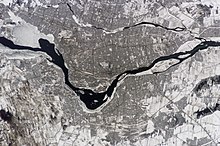
The island of Montreal at the confluence of the Saint Lawrence and Ottawa rivers.
Montreal is in the southwest of the province of Quebec. The city covers most of the Island of Montreal at the confluence of the Saint Lawrence and Ottawa Rivers. The port of Montreal lies at one end of the Saint Lawrence Seaway, the river gateway that stretches from the Great Lakes to the Atlantic.[84] Montreal is defined by its location between the Saint Lawrence river to its south and the Rivière des Prairies to its north. The city is named after the most prominent geographical feature on the island, a three-head hill called Mount Royal, topped at 232 m (761 ft) above sea level.[85]
Montreal is at the centre of the Montreal Metropolitan Community, and is bordered by the city of Laval to the north; Longueuil, Saint-Lambert, Brossard, and other municipalities to the south; Repentigny to the east and the West Island municipalities to the west. The anglophone enclaves of Westmount, Montreal West, Hampstead, Côte Saint-Luc, the Town of Mount Royal and the francophone enclave Montreal East are all surrounded by Montreal.[86]
Yes, iScano's services can monitor and analyze structural deformations, providing valuable insights for maintenance and safety in existing buildings and infrastructure in Montreal.
Yes, iScano's services are scalable and adaptable, catering to the needs of both large and small-scale construction projects in Montreal.
Yes, iScano's technology is adept at capturing intricate details, making it invaluable for heritage preservation projects in the historic regions of Montreal.
iScano employs advanced surveying techniques and high-resolution laser scanners to ensure accuracy in capturing data for large-scale construction projects in the metropolitan area.